Bacalar Stromatolites: Living Windows Into Earth’s Ancient Past
Hidden beneath the turquoise beauty of the Lagoon of Seven Colors is an extraordinary ecosystem built by microscopic life. Discover what Bacalar’s stromatolites and microbialites are, how they form, why scientists study them and why protecting them matters.
Bacalar is famous for spectacular shades of blue, but one of the lagoon’s most remarkable natural treasures is much easier to overlook. Along parts of its shoreline live large microbialite formations — mineral structures created through the long interaction of microorganisms, minerals and the surrounding water.
At first glance, they can look like ordinary rocks. Yet their surfaces support complex microbial communities participating in chemical and biological processes that can gradually build carbonate structures over time.
These formations are especially fascinating because similar microbial processes have existed for an enormous portion of Earth’s history. Fossil stromatolites occur in rocks more than three billion years old, making their modern counterparts valuable natural laboratories for scientists studying early life, microbial ecology and the relationship between biology and geology.
What Are Stromatolites?
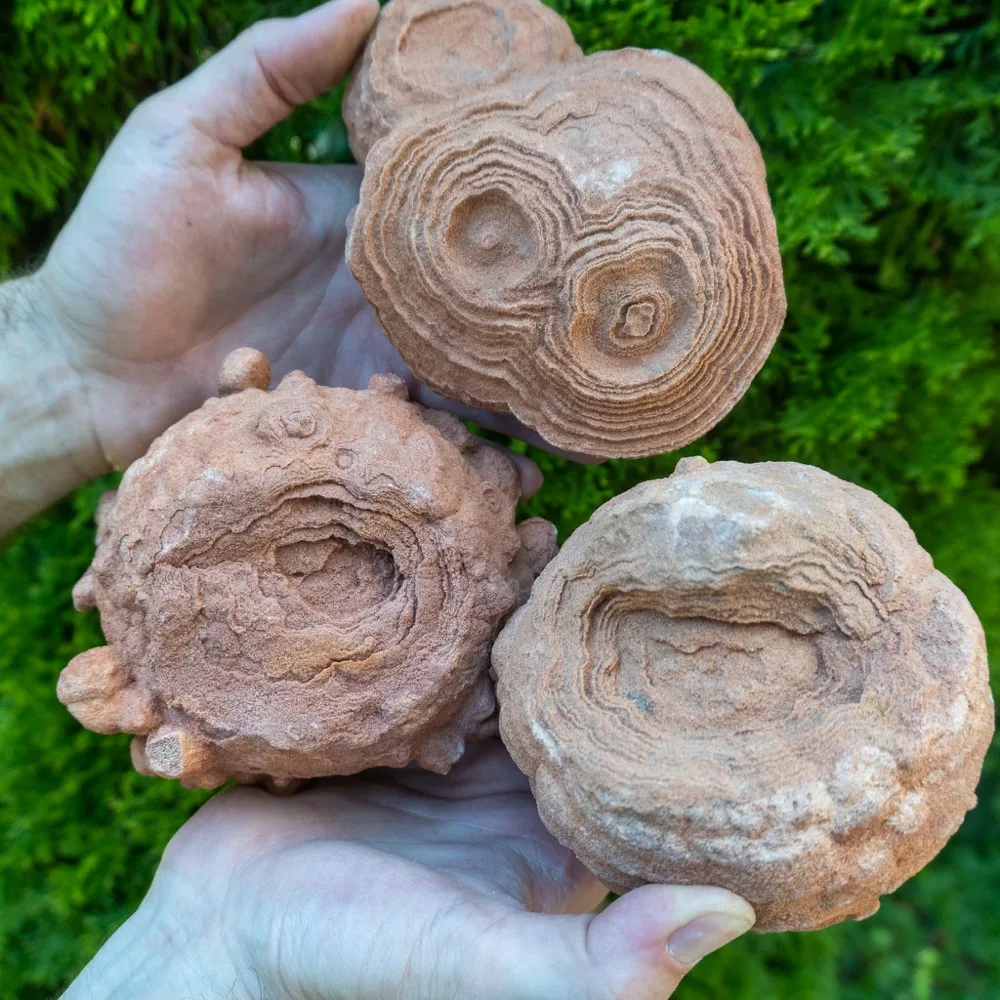
Stromatolites are layered organosedimentary structures commonly associated with microbial mats. Over time, microbial activity, sediment trapping and mineral precipitation can create repeated layers that become part of the structure.
The important distinction is that a stromatolite is not a single organism. It is better understood as a structure produced through the interaction of microbial communities with their physical and chemical environment.
The mineral structure itself is not an animal or plant. What makes modern microbialites biologically active is the living microbial community associated with their surface and internal environments.
Stromatolites, Microbialites and Thrombolites: What Is the Difference?
Tourism articles often use the word stromatolite for every rock-like microbial formation in Bacalar. Scientifically, the broader term microbialite is often more accurate.
Microbialite
The broad category for sedimentary or mineral structures formed through microbial processes.
Stromatolite
A type of microbialite characterized especially by visible layered or laminated internal structures.
Thrombolite
A microbialite with a more irregular, clotted internal texture rather than continuous layering.
Bacalar contains diverse microbialite morphologies, which is why scientific publications generally discuss the lagoon as an important freshwater microbialite ecosystem.
Why Is Bacalar So Special?
Laguna Bacalar lies within the limestone-rich karst landscape of the Yucatán Peninsula. Groundwater moving through carbonate rocks, the chemical composition of the lagoon and microbial activity combine to create unusual conditions in which large freshwater microbialites can develop.
Researchers have described Bacalar as hosting one of the world’s most extensive occurrences of freshwater microbialites. They are found around multiple areas of the lagoon rather than existing as one isolated formation.
The lagoon is also unusual because of its sulfate-rich freshwater chemistry. Studies of Bacalar microbialites reveal microbial communities far more complex than the simple idea that cyanobacteria alone are responsible for building them.
How Do Bacalar’s Microbialites Form?
The process is slow and involves a combination of biology, mineral chemistry and environmental conditions.
Microorganisms grow in communities on and within the surface. Their metabolism changes the chemistry of the surrounding microenvironment. Under suitable conditions, carbonate minerals can precipitate and become incorporated into the structure.
Sediments, microorganisms and mineral precipitation therefore interact repeatedly, slowly creating increasingly complex formations.
More Than Cyanobacteria
Cyanobacteria are frequently associated with stromatolites because many species perform photosynthesis and can be visually prominent in microbial mats.
Research in Bacalar, however, has found highly diverse microbial communities including Proteobacteria, Chloroflexi and other bacterial groups. Sulfate-reducing bacteria are particularly interesting because researchers have proposed that their metabolism may contribute significantly to carbonate precipitation within the microbialites.
How Old Are Stromatolites?
This is where one of the most common myths about Bacalar needs clarification.
Stromatolites occur in the geological record from more than 3.4 billion years ago, and ancient examples are among the most important evidence used to investigate early life on Earth.
But this does not mean that the individual microbialite structures visitors see in Bacalar are billions of years old.
Modern Bacalar microbialites are contemporary ecosystems. Their scientific importance comes partly from the fact that processes occurring today can help researchers understand how similar microbial ecosystems may have interacted with the environment deep in Earth’s history.
Bacalar’s microbialites are modern ecosystems, but the type of biological and mineral interaction they represent has very ancient roots in Earth’s history.
What Do Bacalar Stromatolites Look Like?
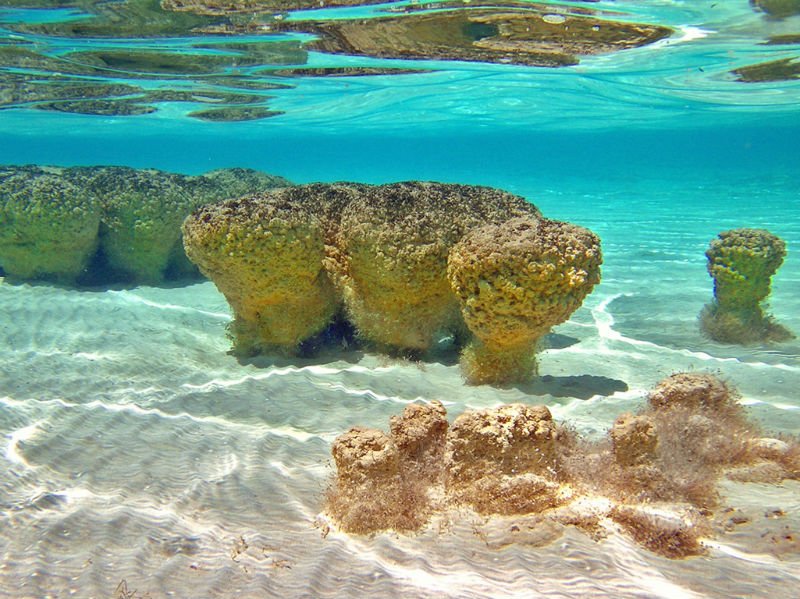
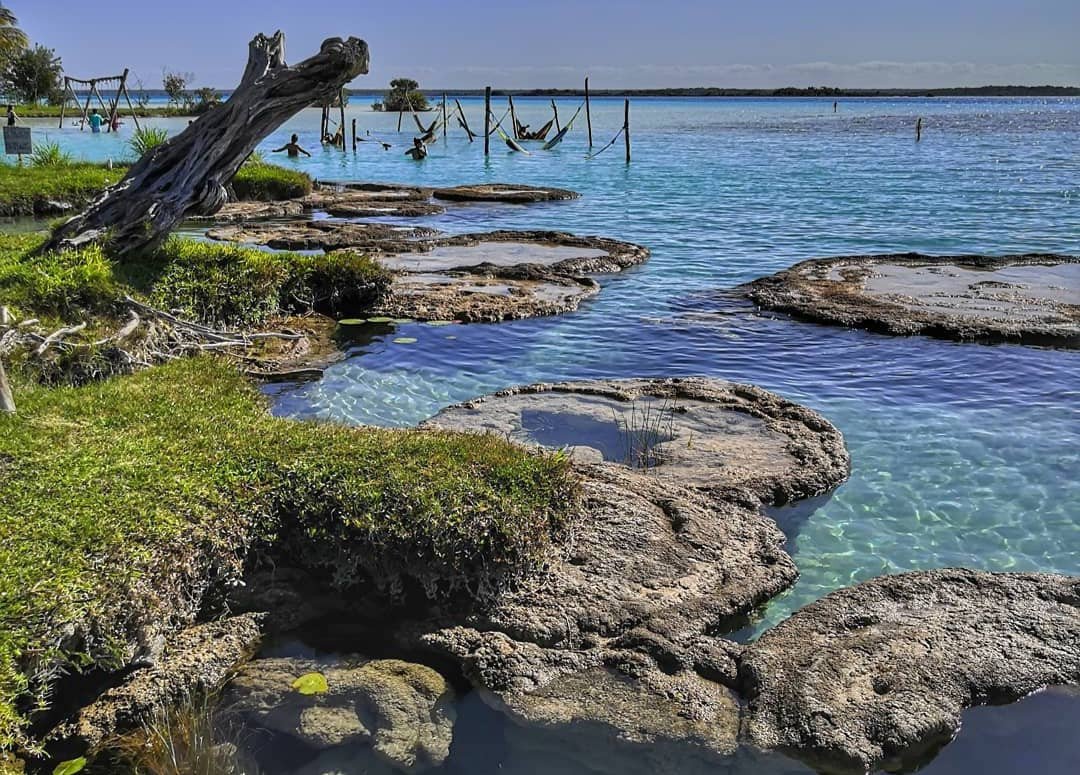
Depending on location and growth conditions, Bacalar’s microbialites may form rounded domes, irregular masses, shoreline structures or broad reef-like formations.
From above the water they may resemble porous gray or brown rocks. Underwater, however, their shape, texture and relationship with the surrounding ecosystem become much easier to appreciate.
Some formations are substantial, which is one reason Bacalar has attracted international scientific attention.
Stromatolites & Microbialites of Bacalar
Why Are Bacalar’s Microbialites Important?
Their importance extends far beyond their unusual appearance.
They Are Natural Laboratories
Modern microbialites allow scientists to observe interactions between microbial metabolism, mineral precipitation, water chemistry and sediment formation in real time.
They Help Us Study Early Earth
Ancient stromatolites form an important part of the geological record of early life. Studying modern analogues helps researchers develop better models for interpreting structures preserved in very old rocks.
They Are Part of Bacalar’s Ecosystem
Microbialites are not museum objects isolated from nature. They exist within a connected aquatic system that includes groundwater, microorganisms, aquatic vegetation, mangroves, sediments and the lagoon’s distinctive water chemistry.
What Threatens Bacalar’s Microbialites?
Bacalar’s beauty has brought rapidly increasing attention to the region. Responsible tourism can help people appreciate and protect the lagoon, but environmental pressure can also alter the conditions that make its microbial communities possible.
Scientific research has identified pressures including intensive tourism, agricultural activity, nutrient inputs, landfill leachate and insufficient wastewater treatment infrastructure. Changes in nutrient levels and water quality may alter microbial community composition and reduce microbial diversity.
Because microbialites develop through slow biological and mineral processes, physical damage can also have long-lasting consequences.
How to Help Protect Bacalar’s Stromatolites
- Never stand or walk on microbialite formations.
- Do not touch, break or collect pieces.
- Observe them from a respectful distance.
- Follow navigation and protected-area rules.
- Avoid disturbing mangroves and sensitive shoreline habitats.
- Choose responsible operators who explain and respect the lagoon’s ecosystem.
- Leave the lagoon exactly as you found it.
Seeing Bacalar Through Different Eyes
Knowing the story behind the lagoon changes the experience.
Bacalar is no longer simply a beautiful body of turquoise water. It becomes a living landscape shaped by geology, groundwater, microorganisms and time.
Understanding what lies beneath the surface is also one of the best reasons to travel responsibly. A visitor does not need to touch a microbialite to appreciate it. In fact, observing it without disturbing it is part of protecting the experience for future generations.
Frequently Asked Questions
Are the stromatolites in Bacalar alive?
The mineral structure itself is not a single living organism. Modern microbialites contain active microbial communities living on and within the structure.
Are Bacalar’s stromatolites billions of years old?
No. Ancient stromatolites appear in rocks billions of years old, but the microbialites currently growing in Bacalar are modern formations. They are valuable partly because they help scientists study processes with very ancient evolutionary origins.
Can you touch stromatolites in Bacalar?
They should be observed without touching, walking or standing on them. Physical contact can damage delicate microbial surfaces and the structures they create.
Can you swim in Bacalar?
Swimming is one of Bacalar’s most famous experiences, but visitors should respect local restrictions and maintain a safe distance from sensitive microbialite formations and other protected habitats.
Why are stromatolites important to science?
They help researchers understand relationships between microorganisms, mineral formation and environmental chemistry. Fossil stromatolites also provide important evidence for investigating early life on Earth.
What is the difference between a stromatolite and a microbialite?
Microbialite is the broader scientific category. Stromatolites are microbialites characterized by layered structures, while thrombolites generally have a more clotted internal texture.
Is Bacalar one of the most important microbialite sites?
Scientific studies describe Laguna Bacalar as hosting one of the world’s most extensive occurrences of modern freshwater microbialites, making the lagoon an important site for microbial ecology and geobiology research.
Discover the Lagoon of Seven Colors
Experience Bacalar with Costa Maya Paradise and discover the landscapes, natural history and extraordinary ecosystems that make this corner of the Mexican Caribbean so special.
Scientific Sources & Further Reading
- The microbiome of modern microbialites in Bacalar Lagoon, Mexico — PLOS ONE / Universidad Nacional Autónoma de México and El Colegio de la Frontera Sur.
- Microbial diversity and biomarker analysis of modern freshwater microbialites from Laguna Bacalar, Mexico — Geobiology.
- Karst environments of the southeastern Yucatán Peninsula: hotspots for modern freshwater microbialites.
- Research on Archean stromatolites from the Pilbara region of Western Australia and the geological record of early life.